Gilles Deleuze
Translated by Daniel W. Smith
Chapters 1–6 of Francis Bacon: The Logic of Sensation, by Gilles Deleuze. English translation by Daniel W. Smith. This excerpt corresponds to pages 5–38 of the University of Minnesota Press edition (2003).
Editorial note: Numbers in square brackets identify paintings in the book’s index. Superscript references use chapter.note numbering. The paintings and the endnote texts are not included in the supplied excerpt; these references have been preserved. The text below is the English source text, not a translation of the Persian version.
- Chapter 1: The Round Area, the Ring
- Chapter 2: Note on Figuration in Past Painting
- Chapter 3: Athleticism
- Chapter 4: Body Meat and Spirit Becoming Animal
- Chapter 5: Recapitulative Note Bacon’s Periods and Aspects
- Chapter 6: Painting and Sensation
Chapter 1: The Round Area, the Ring
The round area and its analogues — Distinction between the Figure and the figurative — The fact — The question of “matters of fact” — The three elements of painting: structure, Figure, and contour — Role of the fields
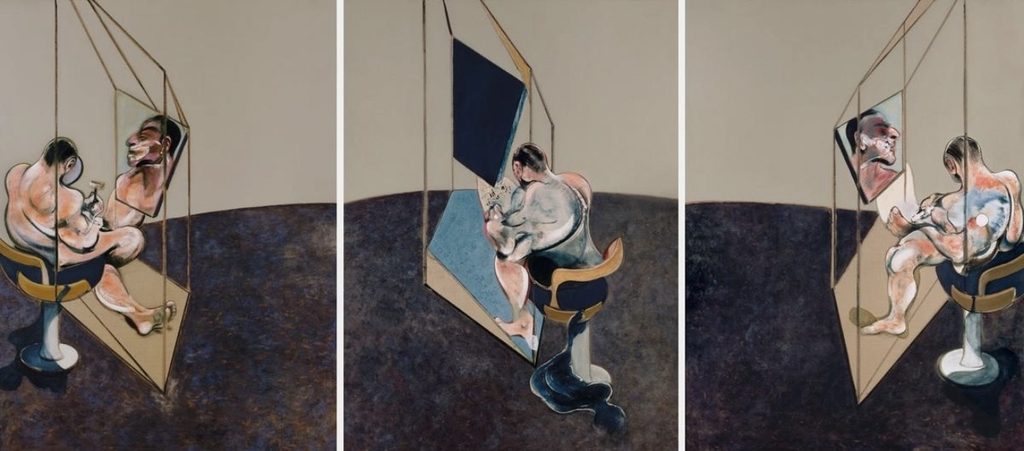
A round area often delimits the place where the person—that is to say, the Figure — is seated, lying down, doubled over, or in some other position. This round or oval area takes up more or less space: it can extend beyond the edges of the painting [64, 37] or occupy the center of a triptych [60, 61]. It is often duplicated, or even replaced, by the roundness of the chair on which the person is seated, or by the oval of the bed on which the person is lying. It can be dispersed in the small disks that surround a part of the person’s body, or in the gyratory spirals that encircle the bodies. Even the two peasants in Two Men Working in a Field [66] form a Figure only in relation to an awkward plot of land, tightly confined within the oval of a pot. In short, the painting is composed like a circus ring, a kind of amphitheater as “place.” It is a very simple technique that consists in isolating the Figure. There are other techniques of isolation: putting the Figure inside a cube, or rather, inside a parallelepiped of glass or ice [6, 55]; sticking it onto a rail or a stretched-out bar, as if on the magnetic arc of an infinite circle [62]; or combining all these means – the round area, the cube, and the bar – as in Bacon’s strangely flared and curved armchairs [38].
These are all “places” [lieux]. In any case, Bacon does not hide the fact that these techniques are rather rudimentary, despite the subtlety of their combinations. The important point is that they do not consign the Figure to immobility but, on the contrary, render sensible a kind of progression, an exploration of the Figure within the place, or upon itself. It is an operative field. The relation of the Figure to its isolating place defines a “fact”: “the fact is …,” “what takes place is ….” Thus isolated, the Figure becomes an Image, an Icon.
Not only is the painting an isolated reality, and not only does the triptych have three isolated panels (which above all must not be united in a single frame), but the Figure itself is isolated in the painting by the round area or the parallelepiped. Why? Bacon often explains that it is to avoid the figurative, illustrative, and narrative character the Figure would necessarily have if it were not isolated. Painting has neither a model to represent nor a story to narrate. It thus has two possible ways of escaping the figurative: toward pure form, through abstraction; or toward the purely figural, through extraction or isolation. If the painter keeps to the Figure, if he or she opts for the second path, it will be to oppose the “figural” to the figurative.1.1 Isolating the Figure will be the primary requirement. The figurative (representation) implies the relationship of an image to an object that it is supposed to illustrate; but it also implies the relationship of an image to other images in a composite whole that assigns a specific object to each of them. Narration is the correlate of illustration.
A story always slips into, or tends to slip into, the space between two figures in order to animate the illustrated whole.1.2 Isolation is thus the simplest means, necessary though not sufficient, to break with representation, to disrupt narration, to escape illustration, to liberate the Figure: to stick to the fact.
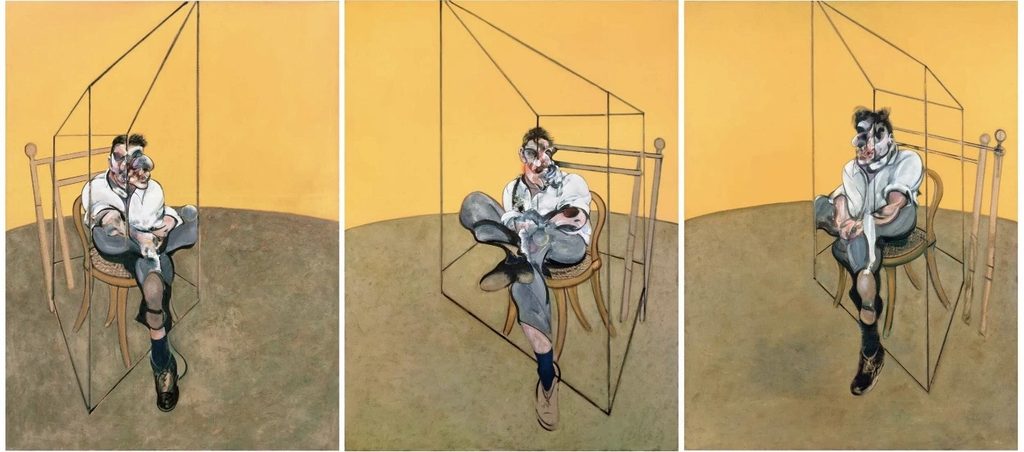
Clearly the problem is more complicated than this. Is there not another type of relationship between Figures, one that would not be narrative, and from which no figuration would follow? Diverse Figures that would spring from the same fact, that would belong to one and the same unique fact rather than telling a story or referring to different objects in a figurative whole? Nonnarrative relationships between Figures, and nonillustrative relationships between the Figures and the fact? Coupled Figures have always been a part of Bacon’s work, but they do not tell a story [60, 61, 66]. Moreover, there is a relationship of great intensity between the separate panels of a triptych, although this relationship has nothing narrative about it [55, 62, 38]. Bacon modestly acknowledges that classical painting often succeeded in drawing this other type of relationship between Figures, and that this is still the task of the painting of the future:
Of course, so many of the greatest paintings have been done with a number of figures on a canvas, and of course every painter longs to do that . . . . But the story that is already being told between one figure and another begins to cancel out the possibilities of what can be done with the paint on its own. And this is a
very great difficulty. But at any moment somebody will come along and be able to put a number of figures on a canvas.”1.3 What is this other type of relationship, a relationship between coupled or distinct Figures? Let us call these new relationships matters of fact,1.4 as opposed to intelligible relations (of objects or ideas). Even if we acknowledge that, to a large degree, Bacon had already conquered this domain, he did so under more complex aspects than those we have yet considered.
We are still at the simple aspect of isolation. A Figure is isolated within a ring, upon a chair, bed, or sofa, inside a circle or parallelepiped. It occupies only a part of the painting. What then fills the rest of the painting? A certain number of possibilities are already annulled, or without interest, for Bacon. What fills the rest of the painting will be neither a landscape as the correlate of the Figure, nor a ground from which the form will emerge, nor a formless chiaroscuro, a thickness of color on which shadows would play, a texture on which variation would play. Yet we are moving ahead too quickly. For there are indeed, in Bacon’s early works, landscape-Figures like the Van Gogh of 1957 [23]; there are extremely shaded textures, as in Figure in a Landscape (1945) [2] and Figure Study I (1945-6) [4]; there are thicknesses and densities like those of Head II (1949) [5]; and above all, there is that alleged period of ten years which, according to Sylvester, was dominated by the somber, the dark, and the tonal, before Bacon returned to the “clear and precise.”1.5 But destiny can sometimes pass through detours that seem to contradict it.
For Bacon’s landscapes are a preparation for what will later appear as a set of short “involuntary free marks” lining the canvas, asignifying — traits1.6 that are devoid of any illustrative or narrative function: hence the importance of grass, and the irremediably grassy character of these landscapes (Landscape, 1952 [8]; Study of a Figure in Landscape, 1952 [9]; Study of a Baboon, 1953 [14]; Two Figures in the Grass, 1954 [17]). As for the textures, the thick, the dark, and the blurry, they are already preparing for the great technique of local scrubbing [nettoyage local] with a rag, whisk broom, or brush, in which the thickness is spread out over a nonfigurative zone. Clearly these two techniques of local scrubbing and asignifying traits belong to an original system which is neither that of the landscape, nor that of the formless or the ground (although, by virtue of their autonomy, they are apt to “make” a landscape or to “make” a ground, or even to “make” darkness).
In fact, the rest of the painting is systematically occupied by large fields [aplats] of bright, uniform, and motionless color. Thin and hard, these fields have a structuring and spatializing function. They are not beneath, behind, or beyond the Figure, but are strictly to the side of it, or rather, all around it, and are thus grasped in a close view, a tactile or “haptic” view, just as the Figure itself is.1.7 At this stage, when one moves from the Figure to the fields of color, there is no relation of depth or distance, no incertitude of light and shadow. Even the shadows and the blacks are not dark (“I tried to make the shadows as present as the Figure”). If the fields function as a background, they do so by virtue of their strict correlation with the Figures. It is the correlation of two sectors on a single plane, equally close. This correlation, this connection, is itself provided by the place, by the ring or round area, which is the common limit of the two, their contour. This is what Bacon says in a very important statement to which we will frequently recur. He distinguishes three fundamental elements in his painting, which are the material structure, the round contour, and the raised image.
If we think in sculptural terms, we would have to say: the armature; the pedestal, which would be mobile; and the Figure, which would move along the armature together with the pedestal. If we had to illustrate them (and to a certain degree this is necessary, as in Man with Dog of 1953 [15]), we would say: a sidewalk, some pools, and the people who emerge from the pools on the way to their “daily round.”1.8
We will see later what the various elements of this system have to do with Egyptian art, Byzantine art, and so forth. But what concerns us here is this absolute proximity, this co-precision, of the field that functions as a ground, and the Figure that functions as a form, on a single plane that is viewed at close range. It is this system, this coexistence of two immediately adjacent sectors, which encloses space, which constitutes an absolutely closed and revolving space, much more so than if one had proceeded with the somber, the dark, or the indistinct. This is why there is indeed a certain blurriness in Bacon; there are even two kinds of blurriness, but they both belong to this highly precise system. In the first case, the blur is obtained not by indistinctness, but on the contrary by the operation that “consists in destroying clarity by clarity,”1.9 as in the man with the pig’s head in the Self- Portrait of 1973 [72], or the treatment of crumpled newspapers: as Leiris says, their typographic characters are clearly drawn, and it is their very mechanical precision that stands opposed to their legibility.1.10 In the other case, the blur is obtained by the techniques of free marks or scrubbing, both of which are also among the precise elements of the system.
(We will see that there is yet a third case.)
Chapter 2: Note on Figuration in Past Painting
Painting, religion, and photography — On two misconceptions
Painting has to extract the Figure from the figurative. But Bacon invokes two developments which seem to indicate that modern painting has a different relation to figuration or illustration than the painting of the past has. First, photography has taken over the illustrative and documentary role, so that modern painting no longer needs to fulfill this function, which still burdened earlier painters. Second, painting used to be conditioned by certain “religious possibilities” that still gave a pictorial meaning to figuration, whereas modern painting is an atheistic game.2.1
Yet it is by no means certain that these two ideas, taken from Malraux, are adequate. On the one hand, such activities are in competition with each other, and one art would never be content to assume a role abandoned by another. It is hard to imagine an activity that would take over a function relinquished by a superior art. The photograph, though instantaneous, has a completely different ambition than representing, illustrating, or narrating. And when Bacon speaks of his own use of photographs, and of the relationships between photography and painting, he has much more profound things to say. On the other hand, the link between the pictorial element and religious sentiment, in past painting, in turn seems poorly defined by the hypothesis of a figurative function that was simply sanctified by faith.
Consider an extreme example: El Greco’s The Burial of the Count of Orgaz (1586-8) [106]. A horizontal divides the painting into two parts: upper and lower, celestial and terrestrial. In the lower half, there is indeed a figuration or narration that represents the burial of the count, although all the coefficients of bodily deformation, and notably elongation, are already at work. But in the upper half, where the count is received by Christ, there is a wild liberation, a total emancipation: the Figures are lifted up and elongated, refined without measure, beyond all constraint. Despite appearances, there is no longer a story to tell; the Figures are relieved of their representative role, and enter directly into relation with an order of celestial sensations. This is what Christian painting had already discovered in the religious sentiment: a properly pictorial atheism, where one could adhere literally to the idea that God must not be represented. With God – but also with Christ, the Virgin, and even Hell – lines, colors, and movements are freed from the demands of representation. The Figures are lifted up, or doubled over, or contorted, freed from all figuration.
They no longer have anything to represent or narrate, since in this domain they are content to refer to the existing code of the Church. Thus, in themselves, they no longer have to do with anything but “sensations” – celestial, infernal, or terrestrial sensations. Everything is made to pass through the code; the religious sentiment is painted in all the colors of the world. One must not say, “If God does not exist, everything is permitted.” It is just the opposite. For with God, everything is permitted. It is with God that everything is permitted, not only morally, since violences and infamies always find a holy justification, but aesthetically, in a much more important manner, because the divine Figures are wrought by a free creative work, by a fantasy in which everything is permitted. Christ’s body is fashioned by a truly diabolical inspiration that makes it pass through all the “areas of sensation,” through all the “levels of different feelings.” Consider two further examples. In Giotto’s Stigmatization of St. Francis (1297- 1300) [105], Christ is transformed into a kite in the sky, a veritable airplane, which sends the stigmata to St.
Francis, while the hatched lines that trace the path to the stigmata are like free marks, which the Saint manipulates as if they were the strings of the airplane-kite. Or Tintoretto’s Creation of the Animals (c. 1550) [109]: God is like a referee firing the gun at the start of a handicapped race, in which the birds and the fish take off first, while the dog, the rabbits, the cow, and the unicorn await their turn.
Thus we cannot say that it was religious sentiment that sustained figuration in the painting of the past; on the contrary, it made possible a liberation of Figures, the emergence of Figures freed from all figuration. Nor can we say that the renunciation of figuration was easier for modern painting as a game. On the contrary, modern painting is invaded and besieged by photographs and clichés that are already lodged on the canvas before the painter even begins to work. In fact, it would be a mistake to think that the painter works on a white and virgin surface. The entire surface is already invested virtually with all kinds of clichés, which the painter will have to break with. This is exactly what Bacon says when he speaks of the photograph: it is not a figuration of what one sees, it is what modern man sees.2.2 It is not dangerous simply because it is figurative, but because it claims to reign over vision, and thus to reign over painting. Having renounced the religious sentiment, but besieged by the photograph, modern painting finds itself in a situation that, despite appearances, makes it much more difficult to break with the figuration that would seem to be its miserable reserved domain.
Abstract painting attests to this difficulty: the extraordinary work of abstract painting was necessary in order to tear modern art away from figuration. But is there not another path, more direct and more sensible?
Chapter 3: Athleticism
First movement: from the structure to the Figure — Isolation — Athleticism — Second movement: from the Figure to the structure — The body escapes from itself: abjection — Contraction, dissipation: washbasins, umbrellas, and mirrors
Let us return to Bacon’s three pictorial elements: the large fields as a spatializing material structure; the Figure, the Figures and their fact; and the place – that is, the round area, the ring, or the contour, which is the common limit of the Figure and the field. The shape of the contour seems to be very simple: round or oval; it is rather its color that poses problems, because of the dynamic double relationship in which it is caught up. The contour, as a “place,” is in fact the place of an exchange in two directions: between the material structure and the Figure, and between the Figure and the field. The contour is like a membrane through which this double exchange flows. Something happens in both directions. If painting has nothing to narrate and no story to tell, something is happening all the same, something which defines the functioning of the painting.
Within the round area, the Figure is sitting on the chair, lying on the bed, and sometimes it even seems to be waiting for what is about to happen. But what is happening, or is about to happen, or has already happened, is not a spectacle or a representation. In Bacon, these waiting Figures or “attendants” are not spectators. One discovers in Bacon’s paintings an attempt to eliminate every spectator, and consequently every spectacle. Thus the 1969 bullfight exists in two versions: in the first, the large field still includes an open panel through which we can glimpse a crowd, like a Roman legion at an amphitheater [56]; but the second version closes off this panel, and is no longer content merely to intertwine the two Figures of the toreador and the bull, but truly achieves their unique or common fact, while at the same time the mauve stripe disappears, which linked the spectators to what was still a spectacle [57]. Three Studies of Isabel Rawsthorne (1967) [43] shows the Figure closing the door on an intruder or visitor, even if this is its own double. In many cases there seems to subsist, distinct from the Figure, a kind of spectator, a voyeur, a photograph, a passerby, an “attendant”: notably, but not exclusively [59], in the triptychs, where it is almost a law.
However, we will see that, in his paintings and especially in his triptychs, Bacon needs the function of an attendant, which is not a spectator but part of the Figure. Even the simulacra of photographs, hung on a wall or a railing, can play this role of an attendant. They are attendants not in the sense of spectators, but as a constant or point of reference in relation to which a variation is assessed. The sole spectacle is in fact the spectacle of waiting or effort, but these are produced only when there are no longer any spectators. This is where Bacon resembles Kafka: Bacon’s Figure is the great Scandal, or the great Swimmer who does not know how to swim, the champion of abstinence; and the ring, the amphitheater, the platform is the theater of Oklahoma. In this respect, everything in Bacon reaches its culmination in the Painting of 1978 [81]: stuck onto a panel, the Figure tenses its entire body and a leg, in order to turn the key in the door with its foot from the other side of the painting. We note that the contour or the round area, a very beautiful golden orange, is no longer on the ground but has migrated, and is now situated on the door itself, so that the Figure seems to be standing up on the vertical door at the extreme point of the foot, in a reorganization of the entire painting.
In this attempt to eliminate the spectator, the Figure already demonstrates a singular athleticism, all the more singular in that the source of the movement is not in itself. Instead, the movement goes from the material structure, from the field, to the Figure. In many paintings, the field is caught up in a movement that forms it into a cylinder: it curls around the contour, around the place; and it envelops and imprisons the Figure. The material structure curls around the contour in order to imprison the Figure, which accompanies the movement of all the structure’s forces. It is the extreme solitude of the Figures, the extreme confinement of the bodies, which excludes every spectator: the Figure becomes a Figure only through this movement which confines it and in which it confines itself. “Abode where lost bodies roam each searching for its lost one [dépeupleur] . . . . Inside a flattened cylinder fifty metres round and eighteen high for the sake of harmony. The light. Its dimness. Its yellowness.”3.1 Either the fall is suspended in the black hole of the cylinder [44J: this is the first formula for a derisory athletics, a violent comedy in which the bodily organs are prostheses.
Or else the place, the contour, becomes an apparatus for the Figure’s gymnastics on the fields of color [60].
But the other movement, which obviously coexists with the first, is on the contrary the movement of the Figure toward the material structure, toward the field of color. From the start, the Figure has been a body, and the body has a place within the enclosure of the round area. But the body is not simply waiting for something from the structure, it is waiting for something inside itself, it exerts an effort upon itself in order to become a Figure. Now it is inside the body that something is happening; the body is the source of movement. This is no longer the problem of the place, but rather of the event. If there is an effort, and an intense effort, it is in no way an extraordinary effort, as if it were a matter of undertaking something above and beyond the strength of the body and directed toward a separate object. The body exerts itself in a very precise manner, or waits to escape from itself in a very precise manner. It is not I who attempt to escape from my body, it is the body that attempts to escape from itself by means of . . . . in short, a spasm: the body as plexus, and its effort or waiting for a spasm.
Perhaps this is Bacon’s approximation of horror or abjection. There is one painting that can guide us, the Figure at a Washbasin of 1976 [80]: clinging to the oval of the washbasin, its hands clutching the faucets, the body-Figure exerts an intense motionless effort upon itself in order to escape down the blackness of the drain. Joseph Conrad describes a similar scene in which he too saw the image of abjection: in the hermetic cabin of the ship, during a wild tempest, the “nigger” of the Narcissus hears the other sailors who have succeeded in carving a small hole in the bulkhead that imprisons him. It is one of Bacon’s paintings.
That infamous nigger rushed at the hole, put his lips to it, and whispered “Help” in an almost extinct voice; he pressed his head to it, trying madly to get out through that opening one inch wide and three inches long. In our disturbed state we were absolutely paralyzed by his incredible action. It seemed impossible to drive him away.3.2 The standard formula, “To pass through the eye of a needle,” trivializes this abomination or Destiny. It is a scene of hysteria. The entire series of spasms in Bacon is of this type: scenes of love, of vomiting and excreting [73], in which the body attempts to escape from itself through one of its organs in order to rejoin the field or material structure. Bacon has often said that, in the domain of Figures, the shadow has as much presence as the body; but the shadow acquires this presence only because it escapes from the body; the shadow is the body that has escaped from itself through some localized point in the contour [63]. And the scream, Bacon’s scream, is the operation through which the entire body escapes through the mouth [6]. All the pressures of the body .
. . .
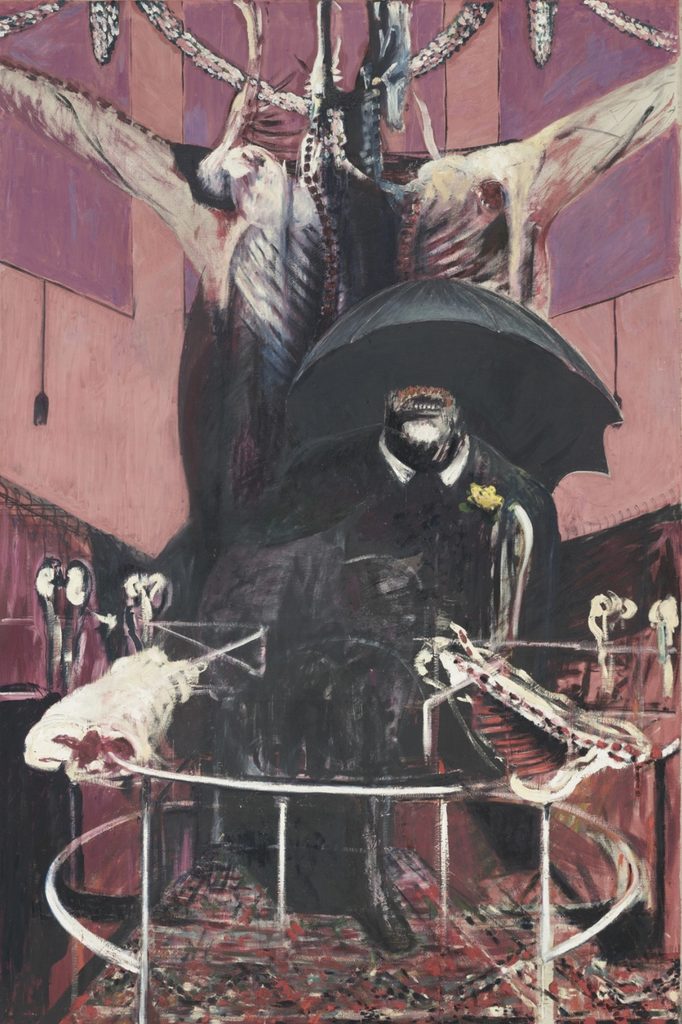
The bowl of the washbasin is a place, a contour, it is a replication of the round area. But here, the new position of the body in relation to the contour shows that we have arrived at a more complex aspect (even if this aspect was there from the start). It is no longer the material structure that curls around the contour in order to envelop the Figure, it is the Figure that wants to pass through a vanishing point in the contour in order to dissipate into the material structure. This is the second direction of the exchange, and the second form of a derisory athletics. The contour thus assumes a new function, since it no longer lies flat, but outlines a hollow volume and has a vanishing point. Bacon’s umbrellas, in this respect, are analogues of the washbasin. In the two versions of Painting, 1946 and 1971 [3, 65], the Figure is clearly lodged within the round area of a balustrade, but at the same time it lets itself be grabbed by the half-spherical umbrella, and appears to be waiting to escape in its entirety through the point of the instrument: already we can no longer see anything but its abject smile.
In Studies of the Human Body (1970) [62] and Triptych, May-June 1974 [75], the green umbrella is treated more like a surface, but the crouching Figure uses it all at once as a pendulum, a parachute, a vacuum cleaner, and a nozzle, through which the entire contracted body wants to pass, and which has already grabbed hold of the head. The splendor of these umbrellas as contours, with one point stretched downwards …. In literature, it is William Burroughs who has best evoked this effort of the body to escape through a point or through a hole that forms a part of itself or its surroundings: “Johnny’s body begins to contract, pulling up toward his chin. Each time the contraction is longer. ‘Wheeeeeeee!’ the boy yells, every muscle tense, his whole body strains to empty through his cock.”3.3 In much the same way, Bacon’s Lying Figure with Hypodermic Syringe (1963) [31] is less a nailed-down body (though this is how Bacon describes it) than a body attempting to pass through the syringe and to escape through this hole or vanishing point functioning as a prosthesis-organ.3.4
If the ring or the round area is replicated in the washbasin and the umbrella, the cube or the parallelepiped is also replicated in the mirror. Bacon’s mirrors can be anything you like – except a reflecting surface. The mirror is an opaque and sometimes black thickness [45]. Bacon does not experience the mirror in the same way as Lewis Carroll. The body enters the mirror and lodges itself inside it, itself and its shadow. Hence the fascination: nothing is behind the mirror, everything is inside it [63, 67]. The body seems to elongate, flatten, or stretch itself out in the mirror, just as it contracted itself by going through the hole. If need be, the head is split open by a large triangular crevasse, which will reappear on two sides, and disperse the head throughout the mirror like a lump of fat in a bowl of soup [51]. But in both these cases, the umbrella and the washbasin as much as the mirror, the Figure is no longer simply isolated but deformed; sometimes contracted and aspirated, sometimes stretched and dilated. This is because the movement is no longer that of the material structure curling around the Figure; it is the movement of the Figure going toward the structure and which, at the limit, tends to dissipate into the fields of color.
The Figure is not simply the isolated body, but also the deformed body that escapes from itself. What makes deformation a destiny is that the body has a necessary relationship with the material structure: not only does the material structure curl around it, but the body must return to the material structure and dissipate into it, thereby passing through or into these prostheses-instruments, which constitute passages and states that are real, physical, and effective, and which are sensations and not imaginings. Thus, in many cases, the mirror or the washbasin can be localized; but even then, what is happening in the mirror, or what is about to happen in the washbasin, can be immediately related to the Figure itself. What the mirror shows, or what the washbasin heralds, is exactly what happens to the Figure. The heads are all prepared to receive these deformations (hence the wiped, scrubbed, or rubbed out zones in the portraits of heads). And to the degree that the instruments tend to occupy the whole of the material structure, they no longer even need to be specified: the entire structure can play the role of a virtual mirror, a virtual umbrella or washbasin, to the point where the instrumental deformations are immediately transferred to the Figure.
Thus, in the 1973 Self-Portrait [72] of the man with the pig’s head, the deformation takes place on the spot. Just as the effort of the body is exerted upon itself, so the deformation is static. An intense movement flows through the whole body, a deformed and deforming movement that at every moment transfers the real image onto the body in order to constitute the Figure.
Chapter 4: Body Meat and Spirit Becoming Animal
Man and animal — The zone of indiscernibility — Flesh and bone: the meat descends from the bone — Pity — Head, face, and meat
The body is the Figure, or rather the material of the Figure. The material of the Figure must not be confused with the spatializing material structure, which is positioned in opposition to it. The body is the Figure, not the structure. Conversely, the Figure, being a body, is not the face, and does not even have a face. It does have a head, because the head is an integral part of the body. It can even be reduced to the head. As a portraitist, Bacon is a painter of heads, not faces, and there is a great difference between the two. For the face is a structured, spatial organization that conceals the head, whereas the head is dependent upon the body, even if it is the point of the body, its culmination. It is not that the head lacks spirit; but it is a spirit in bodily form, a corporeal and vital breath, an animal spirit. It is the animal spirit of man: a pig-spirit, a buffalo-spirit, a dog-spirit, a bat-spirit . . . . Bacon thus pursues a very peculiar project as a portrait painter: to dismantle the face, to rediscover the head or make it emerge from beneath the face.
The deformations which the body undergoes are also the animal traits of the head. This has nothing to do with a correspondence between animal forms and facial forms. In fact, the face lost its form by being subjected to the techniques of rubbing and brushing that disorganize it and make a head emerge in its place. And the marks or traits of animality are not animal forms, but rather the spirits that haunt the wiped off parts, that pull at the head, individualizing and qualifying the head without a face.4.1 Bacon’s techniques of local scrubbing and asignifying traits take on a particular meaning here. Sometimes the human head is replaced by an animal; but it is not the animal as a form, but rather the animal as a trait – for example, the quivering trait of a bird spiraling over the scrubbed area, while the simulacra of portrait-faces on either side of it act as “attendants” (as in the 1976 Triptych [79]). Sometimes an animal, for example a real dog, is treated as the shadow of its master [52], or conversely, the man’s shadow itself assumes an autonomous and indeterminate animal existence [73].
The shadow escapes from the body like an animal we had been sheltering. In place of formal correspondences, what Bacon’s painting constitutes is a zone of indiscernibility or undecidability between man and animal. Man becomes animal, but not without the animal becoming spirit at the same time, the spirit of man, the physical spirit of man presented in the mirror as Eumenides or Fate [77]. It is never a combination of forms, but rather the common fact: the common fact of man and animal. Bacon pushes this to the point where even his most isolated Figure is already a coupled Figure; man is coupled with his animal in a latent bullfight.
This objective zone of indiscernibility is the entire body, but the body insofar as it is flesh or meat. Of course, the body has bones as well, but bones are only its spatial structure. A distinction is often made between flesh and bone, and even between things related to them. The body is revealed only when it ceases to be supported by the bones, when the flesh ceases to cover the bones, when the two exist for each other, but each on its own terms: the bone as the material structure of the body, the flesh as the bodily material of the Figure. Bacon admires the young woman in Degas’s After the Bath [101], whose suspended spinal column seems to protrude from her flesh, making it seem much more vulnerable and lithe, acrobatic.4.2 In a completely different context, Bacon has painted such a spinal column on a Figure doubled over in contortions (Three Figures and a Portrait, 1975 [78]). This pictorial tension between flesh and bone is something that must be achieved. And what achieves this tension in the painting is, precisely, meat, through the splendor of its colors. Meat is the state of the body in which flesh and bone confront each other locally rather than being composed structurally.
The same is true of the mouth and the teeth, which are little bones. In meat, the flesh seems to descend from the bones, while the bones rise up from the flesh. This is a feature of Bacon’s that distinguishes him from Rembrandt and Soutine. If there is an “interpretation” of the body in Bacon, it lies in his taste for painting prone Figures, whose raised arm or thigh is equivalent to a bone, so that the drowsy flesh seems to descend from it. Thus, we find the two sleeping twins flanked by animal-spirit attendants in the central panel of the 1968 triptych [53]; but also the series of the sleeping man with raised arms [25], the sleeping woman with vertical legs [28], and the sleeper or addict with the hypodermic syringe [31, 58]. Well beyond the apparent sadism, the bones are like a trapeze apparatus (the carcass) upon which the flesh is the acrobat. The athleticism of the body is naturally prolonged in this acrobatics of the flesh. We can see here the importance of the fall — [chute] in Bacon’s work. Already in the crucifixions, what interests Bacon is the descent, and the inverted head that reveals the flesh.
In the crucifixions of 1962 and 1965, we can see the flesh literally descending from the bones, framed by an armchair-cross and a bone-lined ring [29, 35]. For both Bacon and Kafka, the spinal column is nothing but a sword beneath the skin, slipped into the body of an innocent sleeper by an executioner.4.3 Sometimes a bone will even be added only as an afterthought in a random spurt of paint.
Pity the meat! Meat is undoubtedly the chief object of Bacon’s pity, his only object of pity, his Anglo-Irish pity. On this point he is like Soutine, with his immense pity for the Jew. Meat is not dead flesh; it retains all the sufferings and assumes all the colors of living flesh. It manifests such convulsive pain and vulnerability, but also such delightful invention, color, and acrobatics. Bacon does not say, “Pity the beasts,” but rather that every man who suffers is a piece of meat. Meat is the common zone of man and the beast, their zone of indiscernibility; it is a “fact,” a state where the painter identifies with the objects of his horror and his compassion. The painter is certainly a butcher, but he goes to the butcher’s shop as if it were a church, with the meat as the crucified victim (the Painting of 1946 [3]). Bacon is a religious painter only in butcher’s shops.
I’ve always been very moved by pictures about slaughterhouses and meat, and to me they belong very much to the whole thing of the Crucifixion …. Of course, we are meat, we are potential carcasses. If I go into a butcher shop I always think it’s surprising that I wasn’t there instead of the animal.4.4 Near the end of the eighteenth century, the novelist K. P. Moritz described a person with “strange feelings”: an extreme sense of isolation, an insignificance almost equal to nothingness; the horror of sacrifice he feels when he witnesses the execution of four men, “exterminated and torn to pieces,” and when he sees the remains of these men “thrown on the wheel” or over the balustrade; his certainty that in some strange way this event concerns all of us, that this discarded meat is we ourselves, and that the spectator is already in the spectacle, a “mass of ambulating flesh”; hence his living idea that even animals are part of humanity, that we are all criminals, we are all cattle; and then, his fascination with the wounded animal,
a calf, the head, the eyes, the snout, the nostrils … and sometimes he lost himself in such sustained contemplation of the beast that he really believed he experienced, for an instant, the type of existence of such a being … in short, the question if he, among men, was a dog or another animal had already occupied his thoughts since childhood.4.5 Moritz’s passages are magnificent. This is not an arrangement of man and beast, nor a resemblance; it is a deep identity, a zone of indiscernibility more profound than any sentimental identification: the man who suffers is a beast, the beast that suffers is a man. This is the reality of becoming. What revolutionary person – in art, politics, religion, or elsewhere – has not felt that extreme moment when he or she was nothing but a beast, and became responsible not for the calves that died, but before the calves that died?
But can one say the same thing, exactly the same thing, about meat and the head, namely, that they are the zone of objective indecision between man and animal? Can one say objectively that the head is meat (just as meat is spirit)? Of all the parts of the body, is not the head the part that is closest to the bone? Look again at El Greco or Soutine. Yet Bacon does not seem to think of the head in this manner. The bone belongs to the face, not to the head. According to Bacon, there is no death’s-head. The head is deboned rather than bony, yet it is not at all soft, but firm. The head is of the flesh, and the mask itself is not a death mask, it is a block of firm flesh that has been separated from the bone: hence the studies for a portrait of William Blake [20, 21]. Bacon’s own head is a piece of flesh haunted by a very beautiful gaze emanating from eyes without sockets. And he pays tribute to Rembrandt for having known how to paint a final self-portrait as one such block of flesh without eye sockets.4.6 Throughout Bacon’s work, the relationship between the head and meat runs through a scale of intensity that renders it increasingly intimate.
First, the meat (flesh on one side, bone on the other) is positioned on the edge of the ring or the balustrade where the Figure-head is seated [3]; but it is also the dense, fleshly rain that surrounds the head and dismantles its face beneath the umbrella [65]. The scream that comes out of the Pope’s mouth and the pity that comes out of his eyes have meat as their object [27]. Later, the meat is given a head, through which it takes flight and descends from the cross, as in the two preceding crucifixions [29, 35]. Later still, Bacon’s series of heads will assert their identity with meat, among the most beautiful of which are those painted in the colors of meat, red and blue [26]. Finally, the meat is itself the head, the head becomes the nonlocalized power of the meat, as in the 1950 Fragment of a Crucifixion [7], where the meat howls under the gaze of a dog-spirit perched on top of the cross. Bacon dislikes this painting because of the simplicity of its rather obvious method: it had been enough to hollow out a mouth from solid meat. Still, it is important to understand the affinity of the mouth, and the interior of the mouth, with meat, and to reach the point where the open mouth becomes nothing more than the section of a severed artery, or even a jacket sleeve that is equivalent to an artery, as in the bloodied pillow in the Sweeney Agonistes triptych [46].
The mouth then acquires this power of nonlocalization that turns all meat into a head without a face. It is no longer a particular organ, but the hole through which the entire body escapes, and from which the flesh descends (here the method of free, involuntary marks will be necessary). This is what Bacon calls the Scream, in the immense pity that the meat evokes.
Chapter 5: Recapitulative Note Bacon’s Periods and Aspects
From the scream to the smile: dissipation — Bacon’s three successive periods — The coexistence of all the movements — The functions of the contour
The head-meat is a becoming-animal of man. In this becoming, the entire body tends to escape from itself, and the Figure tends to return to the material structure. We have already seen this in the effort the Figure exerted upon itself in order to pass through the point or the hole; and even more so, in the state it assumed when it went into the mirror on the wall. But it has not yet dissolved into the material structure, it has not yet returned to the field in order to be truly dissipated in it, to be effaced on the wall of the closed cosmos, to melt into a molecular texture. It is this extreme point that will have to be reached in order to allow a justice to prevail that will no longer be anything but Color or Light, a space that will no longer be anything but the Sahara.5.1 Which means that, whatever its importance, becoming-animal is only one stage in a more profound becoming-imperceptible in which the Figure disappears.
The entire body escapes through the screaming mouth. The body escapes through the round mouth of the Pope or the nurse, as if through an artery [16, 24]. According to Bacon, however, this is not the last word in the series of mouths. Bacon suggests that beyond the scream there is the smile, to which, he says, he has not yet been able to gain access.5.2 Bacon is certainly being modest; in fact, he has painted smiles that are among the most beautiful in painting, and which fulfill the strangest function, namely, that of securing the disappearance of the body. Bacon and Lewis Carroll meet on this single point: the smile of a cat.5.3 There is already a disquieting and disappearing smile in the head of the man underneath the umbrella in the Painting of 1946 [3], and the face is dismantled in favor of this smile, as if there were an acid eating away at the body; and the second version of the same man accentuates and straightens the smile [65]. Furthermore, there is the scoffing, almost untenable, and insupportable smile of the 1954 Pope [19] or of the man sitting on the bed [11]: one senses that the smile will survive the effacement of the body.
The eyes and the mouth are so completely caught up in the horizontal lines of the painting that the face is dissipated, in favor of the spatial coordinates in which only the insistent smile remains. How are we to name such a thing? Bacon suggests that this smile is “hysterical.”5.4 An abominable smile, an abjection of a smile. And if one dreams of introducing an order into a triptych, we believe that the 1953 triptych [13] imposes the following order, which is not to be confused with the succession of panels: the screaming mouth in the center, the hysterical smile on the left, and finally, the inclined and dissipated head on the right.5.5
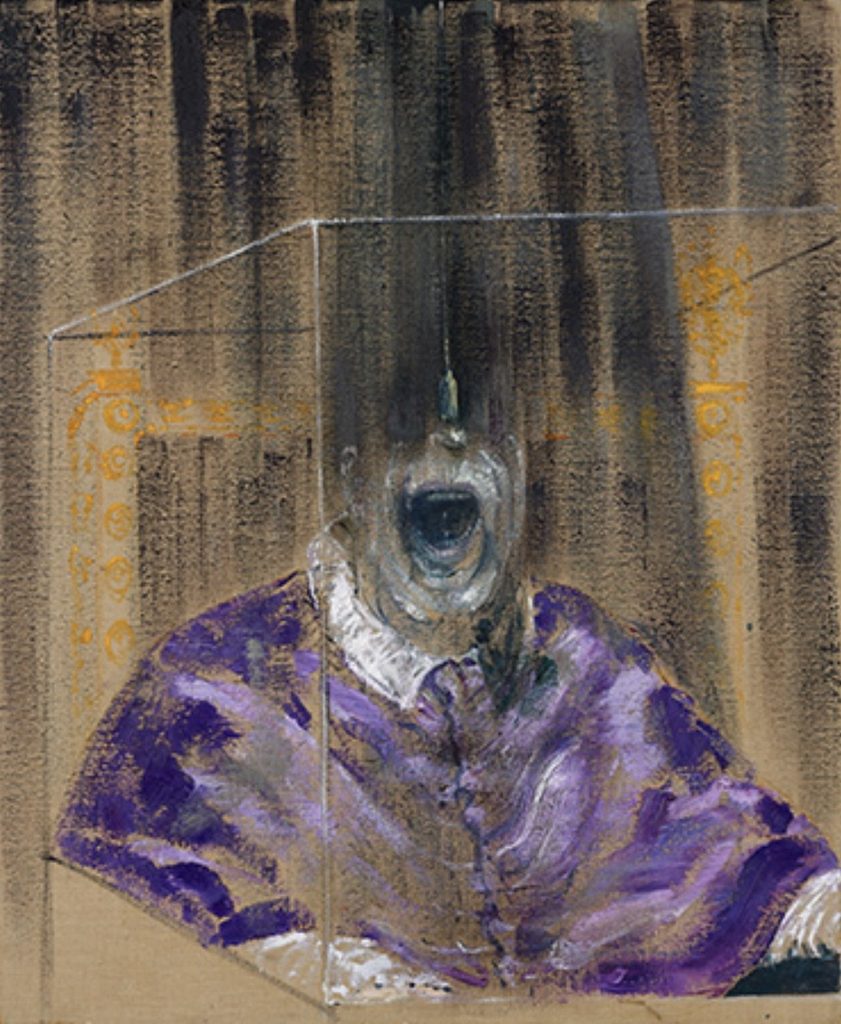
At this extreme point of cosmic dissipation, in a closed but unlimited cosmos, it is clear that the Figure can no longer be isolated or put inside a limit, a ring or parallelepiped: we are faced with different coordinates. The Figure of the screaming Pope [16] is already hidden behind the thick folds (which are almost laths) of a dark, transparent curtain: the top of the body is indistinct, persisting only as if it were a mark on a striped shroud, while the bottom of the body still remains outside the curtain, which is opening out. This produces the effect of a progressive elongation, as if the body were being pulled backwards by its upper half. For a rather long period of time, this technique appeared frequently in Bacon’s works. The same vertical curtain strips surround and partially line the abominable smile of Study for a Portrait [11], while the head and the body seem to sink into the background, into the horizontal slats of the blind. It would seem that during this entire period, conventions were required that are the opposite of those we defined at the outset. We see everywhere the reign of the blurry [flou] — and the indeterminate, the action of a depth that pulls at the form, a thickness on which shadows play, a dark nuanced texture, effects of compression and elongation — In short, a malerisch treatment, as Sylvester suggests.5.6 This is what justifies Sylvester in dividing Bacon’s work into three periods: the first, in which the precise Figure confronts the hard and bright field of color; the second, in which the “malerisch”’ form is drawn against a curtained, tonal background; and finally the third, which brings together the “two opposite conventions” and returns to the vivid and thin ground, while reinventing locally the effects of blurriness by striping and brushing.5.7
Yet it is not only the third period that invents the synthesis of the two. The second period had already not so much contradicted the first period as added to it, in the unity of a style and a creation. A new position of the Figure appears, but one that coexists with the others. At its simplest, the position behind the curtains is combined perfectly with the position on the ring, bar, or parallelepiped, in a Figure that is not only isolated, stuck, and contracted, but also abandoned, escaping, evanescent, and confused, as in the 1952 Study for Crouching Nude [10]. And the Man with Dog of 1953 [15] incorporates the three fundamental elements of painting, but within a scrambled whole where the Figure is nothing but a shadow; the puddle, an uncertain contour; and the sidewalk, a darkened surface. This is indeed the essential point: there is certainly a succession of periods, but there are also coexistent aspects that accord with the three simultaneous elements of painting, which are perpetually present. The armature or material structure, the positioned Figure, and the contour as the limit of the two these will continue to constitute the highly precise system.
It is within this system that the operations of brushing, the phenomena of blurriness, the effects of elongation and fading are produced, and which are all the stronger in that they constitute a movement within this whole that is itself precise.
There will be – or perhaps there would have been reason to distinguish a very recent fourth period. Suppose the Figure no longer had only elements of dissipation, and that it was no longer even content to privilege or return to this element. Suppose the Figure had effectively disappeared, leaving behind only a vague trace of its former presence. The field will then open up like a vertical sky, and at the same time will increasingly take over the structuring functions: the elements of the contour will establish more and more divisions within the field, creating flat sections and regions in space which form a free armature. But at the same time, the scrambled or wiped-off zone, which used to make the Figure emerge, will now stand on its own, independent of every definite form, appearing as a pure Force without an object: the wind of the tempest, the jet of water or vapor, the eye of the hurricane, which reminds one of Turner living in a world that had turned into a steamship [110]. Everything (particularly the black section) is organized around the confrontation of the two adjacent blues, the jet of water and the field of color [82].
The fact that we are familiar with only a few instances of this new organization in Bacon’s work [86, 88, 97] must not make us rule out the possibility that this is a nascent period, which would be characterized by an “abstraction” that no longer has any need of the Figure. The Figure is dissipated by realizing the prophecy: you will no longer be anything but sand, grass, dust, or a drop of water .. . .5.8 The landscape flows on its own outside of the polygon of presentation, retaining the disfigured elements of a sphinx that already seemed to be made of sand. But now the sand no longer retains any Figure; nor does the grass, earth, or water. And a radiant use of pastels lies at the transition between the Figures and these new empty spaces. The sand might even reconstitute the sphinx [83], but it is so fragile and pastelized that we sense that the world of Figures is profoundly threatened by the new power.
If we confine ourselves to the three attested periods, it is difficult to comprehend the coexistence of all these movements. And yet the painting is this coexistence. Given the three basic elements – Structure, Figure, and Contour — a first movement (“tension”) goes from the structure to the Figure. The structure then appears as a field of color, but one that will curl around the contour like a cylinder; the contour appears as an isolator – a round area, an oval, a bar or system of bars; and the Figure is isolated within the contour, in a completely closed world. But it is here that a second movement, a second tension, is brought into play, one that goes from the Figure to the material structure: the contour changes, it turns into the half-sphere of the washbasin or umbrella, the thickness of the mirror, acting as a deformer; the Figure is contracted or dilated in order to pass through a hole or into the mirror; it experiences an extraordinary becoming-animal in a series of screaming transformations; and it itself tends to return to the field of color, to dissipate into the structure with a final smile, through the intermediary of the contour, which no longer acts as a deformer, but as a curtain where the Figure shades off into infinity.
Thus, this most closed of worlds was also the most unlimited. If we confine ourselves to the simplest element, the contour (which begins as a simple circle or round area), we can see the variety of its functions at the same time as the development of its form: it is first of all isolating, the final territory of the Figure; but it is thus already the “depopulator” or the “deterritorializer,” since it forces the structure to curl around the Figure, cutting it off from any natural milieu; it is still a vehicle, since it guides the little stroll of the Figure in its remaining territory; and it is a trapeze apparatus or prosthesis, because it sustains the athleticism of the Figure confined inside it. It then acts as a deformer, when the Figure passes into it through a hole or a point; and it again becomes a trapeze apparatus or prosthesis in a new sense, for the acrobatics of the flesh; and finally, it is the curtain behind which the Figure is dissolved by joining with the structure. In short, it is a membrane, it has never ceased to be a membrane that assures the communication in both directions between the Figure and the material structure.
In the 1978 Painting [81], we can see that the golden orange contour that strikes the door has all these functions, and is ready to assume all these forms. Everything is divided into diastole and systole, with repercussions at each level. The systole, which contracts the body, goes from the structure to the Figure, while the diastole, which extends and dissipates it, goes from the Figure to the structure. But there is already a diastole in the first movement, when the body extends itself in order to better close in on itself; and there is a systole in the second movement, when the body is contracted in order to escape from itself; and even when the body is dissipated, it still remains contracted by the forces that seize hold of it in order to return it to its surroundings. The coexistence of all these movements in the painting …. is rhythm.
Chapter 6: Painting and Sensation
Cézanne and sensation — The levels of sensation — Figuration and violence — The movement of translation, the stroll — The phenomenological unity of the senses: sensation and rhythm
There are two ways of going beyond figuration (that is, beyond both the illustrative and the figurative): either toward abstract form or toward the Figure. Cézanne gave a simple name to this way of the Figure: sensation. The Figure is the sensible form related to a sensation; it acts immediately upon the nervous system, which is of the flesh, whereas abstract form is addressed to the head, and acts through the intermediary of the brain, which is closer to the bone. Certainly Cézanne did not invent this way of sensation in painting, but he gave it an unprecedented status. Sensation is the opposite of the facile and the ready-made, the cliché, but also of the “sensational,” the spontaneous, etc. Sensation has one face turned toward the subject (the nervous system, vital movement, “instinct,” “temperament” — a whole vocabulary common to both Naturalism and Cézanne) and one face turned toward the object (the “fact,” the place, the event). Or rather, it has no faces at all, it is both things indissolubly, it is Being-in-the-World, as the phenomenologists say: at one and the same time I become in the sensation and something happens through the sensation, one through the other, one in the other.6.1 And at the limit, it is the same body that, being both subject and object, gives and receives the sensation.
As a spectator, I experience the sensation only by entering the painting, by reaching the unity of the sensing and the sensed. This was Cézanne’s lesson against the Impressionists: sensation is not in the “free” or disembodied play of light and color (impressions); on the contrary, it is in the body, even the body of an apple. Color is in the body, sensation is in the body, and not in the air. Sensation is what is painted. What is painted on the canvas is the body, not insofar as it is represented as an object, but insofar as it is experienced as sustaining this sensation (what Lawrence, speaking of Cézanne, called “the appleyness of the apple”).6.2
This is the very general thread that links Bacon to Cézanne: paint the sensation, or, as Bacon will say in words very close to Cézanne’s, record the fact6.3 “It is a very, very close and difficult thing to know why some paint comes across directly onto the nervous system and other paint tells you the story in a long diatribe through the brain.”6.4 There would seem to be only obvious differences between these two painters: Cézanne’s world as landscape and still life (even before the portraits, which are treated as landscapes) versus Bacon’s inverted hierarchy that dismisses still lifes and landscapes;6.5 the world as Nature in Cézanne versus the world as artifact in Bacon. But precisely, are not these obvious differences in the service of “sensation” and “temperament”? In other words, are they not inscribed in what links Bacon to Cézanne, in what they have in common? When Bacon speaks of sensation, he says two things, which are very similar to Cézanne. Negatively, he says that the form related to the sensation (the Figure) is the opposite of the form related to an object that it is supposed to represent (figuration).
As Valéry put it, sensation is that which is transmitted directly, and avoids the detour and boredom of conveying a story.6.6 And positively, Bacon constantly says that sensation is what passes from one “order” to another, from one “level” to another, from one “area” to another. This is why sensation is the master of deformations, the agent of bodily deformations. In this regard, the same criticism can be made against both figurative painting and abstract painting: they pass through the brain, they do not act directly upon the nervous system, they do not attain the sensation, they do not liberate the Figure — all because they remain at one and the same level.6.7 They can implement transformations of form, but they cannot attain deformations of bodies. In what sense Bacon is Cézannean, even more so than if he were a disciple of Cézanne, we will have occasion to consider later.
What does Bacon mean when, throughout the interviews, he speaks of “orders of sensation,” “levels of feeling,” “areas of sensation,” or “shifting sequences”?6.8 At first, one might think that each order, level, or area corresponds to a specific sensation: each sensation would thus be a term in a sequence or a series. For example, the series of Rembrandt’s self-portraits involves us in different areas of feeling.6.9 And it is true that painting, and especially Bacon’s painting, proceeds through series: series of crucifixions, series of Popes, series of self-portraits, series of the mouth, of the mouth that screams, the mouth that smiles . . . . Moreover, there can be series of simultaneity, as in the triptychs, which make at least three levels or orders coexist. And the series can be closed, when it has a contrasting composition, but it can be open, when it is continued or continuable beyond the three.6.10 All this is true. But it would not be true were there not something else as well, something that is already at work in each painting, each Figure, each sensation. It is each painting, each Figure, that is itself a shifting sequence or series (and not simply a term in a series); it is each sensation that exists at diverse levels, in different orders, or in different domains.
This means that there are not sensations of different orders, but different orders of one and the same sensation. It is the nature of sensation to envelop a constitutive difference of level, a plurality of constituting domains. Every sensation, and every Figure, is already an “accumulated” or “coagulated” sensation, as in a limestone figure.6.11 Hence the irreducibly synthetic character of sensation. What then, we must ask, is the source of this synthetic character, through which each material sensation has several levels, several orders or domains? What are these levels, and what makes up their sensing or sensed unity?
A first response must obviously be rejected. What makes up the material synthetic unity of a sensation would be the represented object, the figured thing. This is theoretically impossible, since the Figure is opposed to figuration. But even if we observe practically, as Bacon does, that something is nonetheless figured (for instance, a screaming Pope), this secondary figuration depends on the neutralization of all primary figuration. Bacon himself formulates this problem, which concerns the inevitable preservation of a practical figuration at the very moment when the Figure asserts its intention to break away from the figurative. We will see how he resolves the problem. In any case, Bacon has always tried to eliminate the “sensational”, — that is, the primary figuration of that which provokes a violent sensation. This is the meaning of the formula, “I wanted to paint the scream more than the horror.”6.12 When he paints the screaming Pope, there is nothing that might cause horror, and the curtain in front of the Pope is not only a way of isolating him, of shielding him from view; it is rather the way in which the Pope himself sees nothing, and screams before the invisible.
Thus neutralized, the horror is multiplied because it is inferred from the scream, and not the reverse. And certainly it is not easy to renounce the horror, or the primary figuration. Sometimes he has to turn against his own instincts, renounce his own experience. Bacon harbors within himself all the violence of Ireland, and the violence of Nazism, the violence of war. He passes through the horror of the crucifixions, and especially the fragment of the crucifixion, or the head of meat, or the bloody suitcase. But when he passes judgment on his own paintings, he rejects all those that are still too “sensational,” because the figuration that subsists in them reconstitutes a scene of horror, even if only secondarily, thereby reintroducing a story to be told: even the bullfights are too dramatic. As soon as there is horror, a story is reintroduced, and the scream is botched. In the end, the maximum violence will be found in the seated or crouching Figures, which are subjected to neither torture nor brutality, to which nothing visible happens, and yet which manifest the power of the paint all the more.
This is because violence has two very different meanings: “When talking about the violence of paint, it’s nothing to do with the violence of war.”6.13 The violence of sensation is opposed to the violence of the represented (the sensational, the cliché). The former is inseparable from its direct action on the nervous system, the levels through which it passes, the domains it traverses: being itself a Figure, it must have nothing of the nature of a represented object. It is the same with Artaud: cruelty is not what one believes it to be, and depends less and less on what is represented.
A second interpretation must also be rejected, which would confuse the levels of sensation – that is, the valencies of the sensation – with an ambivalence of feeling. At one point, Sylvester suggests, “since you talk about recording different levels of feeling in one image .. . you may be expressing at one and the same time a love of the person and a hostility towards them .. . both a caress and an assault?” To which Bacon responds, “That is too logical. I don’t think that’s the way things work. I think it goes to a deeper thing: how do I feel I can make this image more immediately real to myself? That’s all.”6.14 In fact, the psychoanalytic hypothesis of ambivalence not only has the disadvantage of localizing the ambivalence on the side of the spectator who looks at the painting; for even if we presuppose an ambivalence in the Figure itself, it would refer to feelings that the Figure would experience in relation to represented things, in relation to a narrated story. But there are no feelings in Bacon: there are nothing but affects; that is, “sensations” and “instincts,” according to the formula of naturalism.
Sensation is what determines instinct at a particular moment, just as instinct is the passage from one sensation to another, the search for the “best” sensation (not the most agreeable sensation, but the one that fills the flesh at a particular moment of its descent, contraction, or dilation).
There is a third, more interesting, hypothesis. This would be the motor hypothesis. The levels of sensation would be like arrests or snapshots of motion, which would recompose the movement synthetically in all its continuity, speed, and violence, as in synthetic cubism, futurism, or Duchamp’s Nude [102]. It is true that Bacon is fascinated by the decomposition of movement in Muybridge, which he has used as a subject matter. It is also true that he obtains very intense and violent movements of his own [39], such as George Dyer’s 180 degree turn of the head toward Lucian Freud [42]. More generally, Bacon’s Figures are often frozen in the middle of a strange stroll [68], as in Man Carrying a Child [22] or the Van Gogh [23]. The round area or the parallelepiped that isolates the Figure itself becomes a motor, and Bacon has not abandoned the project that a mobile sculpture could achieve more easily: in this case, the contour or pedestal would slide along the length of the armature so that the Figure could make its “daily round.”6.15 But it is precisely the nature of this daily round that can inform us of the status of movement in Bacon.
Beckett and Bacon have never been so close, and this daily round is the kind of stroll typical of Beckett’s characters: they too trundle about fitfully without ever leaving their circle or parallelepiped. It is the stroll of the paralytic child and its mother clinging to the edge of the balustrade in a curious handicapped race [36]. It is the about-face in Figure Turning [30]. It is George Dyer’s bicycle ride [40], which closely resembles that of Moritz’s hero: “his vision was limited to the small piece of land he could see about him . . . . To him, the end of all things seemed to lead, at the end of his journey, to just such a point .. . ,”6.16 Therefore, even when the contour is displaced, the movement consists less of this displacement than the amoeba-like exploration that the Figure is engaged in inside the contour. Movement does not explain sensation; on the contrary, it is explained by the elasticity of the sensation, its vis elastica. According to Beckett’s or Kafka’s law, there is immobility beyond movement: beyond standing up, there is sitting down, and beyond sitting down, lying down, beyond which one finally dissipates.
The true acrobat is one who is consigned to immobility inside the circle. The large feet of the Figures often do not lend themselves to walking: they are almost clubfeet (and the large armchairs often seem to resemble shoes for clubfeet). In short, it is not movement that explains the levels of sensation, it is the levels of sensation that explain what remains of movement. And in fact, what interests Bacon is not exactly movement, although his painting makes movement very intense and violent. But in the end, it is a movement “in-place,” a spasm, which reveals a completely different problem characteristic of Bacon: the action of invisible forces on the body (hence the bodily deformations, which are due to this more profound cause). In the 1973 triptych [73], the movement of translation occurs between two spasms, between the two movements of a contraction in one place.
Then there would be yet another hypothesis, more “phenomenological.” The levels of sensation would really be domains of sensation that refer to the different sense organs; but precisely each level, each domain would have a way of referring to the others, independently of the represented object they have in common. Between a color, a taste, a touch, a smell, a noise, a weight, there would be an existential communication that would constitute the “pathic” (nonrepresentative) moment of the sensation. In Bacon’s bullfights, for example, we hear the noise of the beast’s hooves [56, 57]; in the 1976 triptych, we touch the quivering of the bird plunging into the place where the head should be [79], and each time meat is represented, we touch it, smell it, eat it, weigh it, as in Soutine’s work; and the portrait of Isabel Rawsthorne [41] causes a head to appear to which ovals and traits have been added in order to widen the eyes, flair the nostrils, lengthen the mouth, and mobilize the skin in a common exercise of all the organs at once. The painter would thus make visible a kind of original unity of the senses, and would make a multisensible Figure appear visually.
But this operation is possible only if the sensation of a particular domain (here, the visual sensation) is in direct contact with a vital power that exceeds every domain and traverses them all. This power is rhythm, which is more profound than vision, hearing, etc. Rhythm appears as music when it invests the auditory level, and as painting when it invests the visual level. This is a “logic of the senses,” as Cézanne said, which is neither rational nor cerebral. What is ultimate is thus the relation between sensation and rhythm, which places in each sensation the levels and domains through which it passes. This rhythm runs through a painting just as it runs through a piece of music. It is diastole-systole: the world that seizes me by closing in around me, the self that opens to the world and opens the world itself.6.17 Cézanne, it is said, is the painter who put a vital rhythm into the visual sensation. Must we say the same thing of Bacon, with his coexistent movements, when the flat field closes in around the Figure and when the Figure contracts or, on the contrary, expands in order to rejoin the field, to the point where the Figure merges with the field? Could it be that Bacon’s closed and artificial world reveals the same vital movement as Cézanne’s Nature? Bacon is not using empty words when he declares that he is cerebrally pessimistic but nervously optimistic, with an optimism that believes only in life.6.18 The same “temperament” as Cézanne? Bacon’s formula would be: figuratively pessimistic, but figurally optimistic.
Source and references
Deleuze, Gilles. Francis Bacon: The Logic of Sensation. Translated and with an introduction by Daniel W. Smith. Afterword by Tom Conley. Minneapolis: University of Minnesota Press, 2003. Chapters 1–6, pp. 5–38.
Editorial note: Numbers in square brackets identify paintings in the book’s index. Superscript references use chapter.note numbering. The paintings and the endnote texts are not included in the supplied excerpt; these references have been preserved. The text below is the English source text, not a translation of the Persian version.