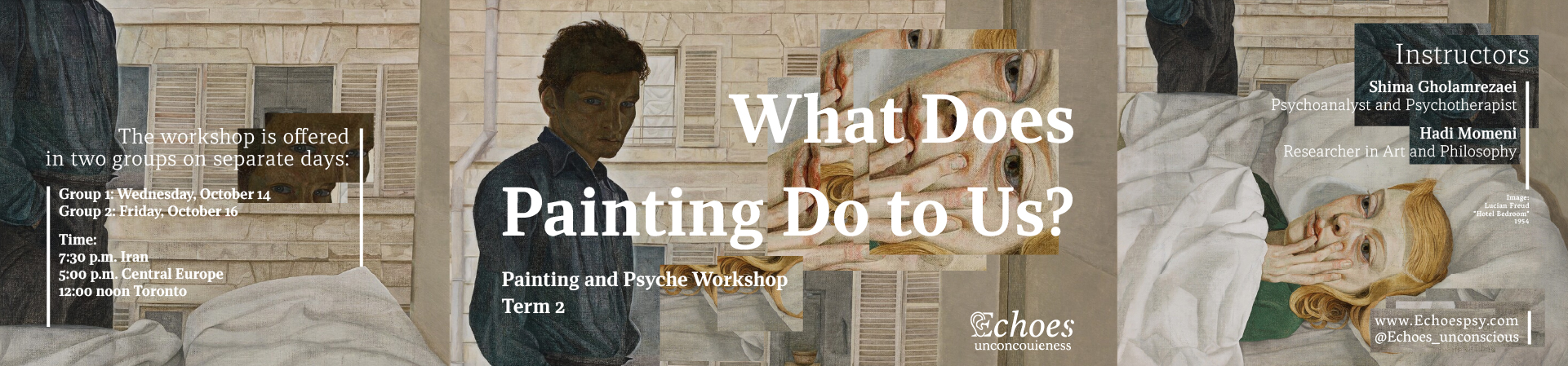
The Second Term of the Painting and Art Workshop
In the first term of our workshop, Painting and the Psyche, we tried to look at art, and more specifically at the medium of painting, from a new perspective across different historical periods and artistic styles. Our focus was on the relationship between the subject and the work of art, and we used the question “What does painting do to us?” as the starting point for our interpretations.
In the second term, we aim to explore the relationship between the subject and the work of art in greater depth and from a different perspective. For this reason, we have given this term the title: “Image, Wound, and Body: From Dream-Work to Mourning and the Collapse of the Subject.”
In this term, we will focus our psychoanalytic lens on what escapes representation and interpretation: where form becomes anxious, the body crosses its own boundaries, the image returns to memory, loss settles into matter, and the subject no longer has the unity and stability we expect it to have.
We will explore the anxiety and uncertainty of looking through Cézanne. Through the works of Van Gogh, Munch, and Ensor, we will examine form as an expression of psychological wounds, anxiety, and the inner struggles of the subject. With Matisse and Picasso, we will explore tension through different forms.
Together, we will interpret portraiture and the representation of the body in the paintings of Bacon, Picasso, Giacometti, and Lucian Freud, where the body appears fragmented, distorted, disintegrated, and in decline.
We will turn to Anselm Kiefer and Gerhard Richter to explore history and mourning for what has been lost but continues to live on within us and in our history.
We will also look at the works of Gaston and, through the anxiety, shame, and violence found in his work, move towards the worlds of Rothko, Agnes Martin, and Cy Twombly. There, we will pause in a world that invites us into an unsettling silence and stillness, and experience the fluid, silent presence of loss as it emerges—something that remains absent when the external world is represented.