
By Nava Tali
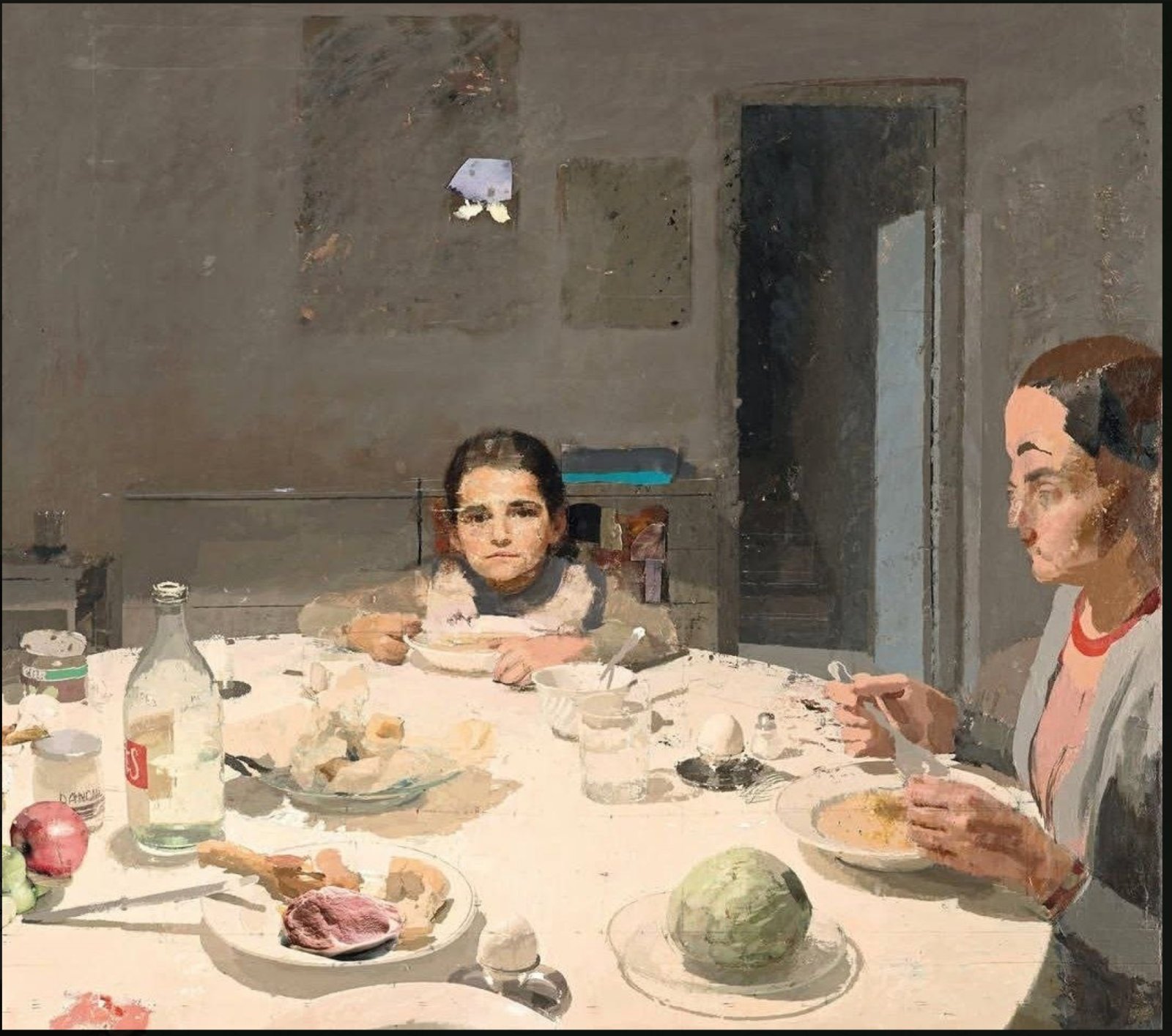
Adapted from a work by Antonio López García
I don’t know why he insisted on wearing light-colored suits — rain, mud, snow, winter, it made no difference. I mean our vocational-skills teacher, Gol-Agha.
Under his jacket he also wore a wool sweater, one of those hand-knitted wool sweaters with a serpentine pattern — one snake, two snakes… four… that’s right, we used to count the snakes.
One winter day — I remember it well — Gol-Agha, as always, had put on his light trousers. It had snowed. The air was icy, but sunny. I don’t know why his trousers looked lighter than ever that day; so light that the line of his underpants showed. Maybe it was the fabric, maybe the icy air. I don’t know exactly. I won’t bore you. Long story short, before the second bell had even rung, Gol-Agha was disgraced.
We, who until that day had only ever seen our fathers’ underpants, the kind that reached down to the knee, now saw the line of Gol-Agha’s too — a little higher and tighter, of course.
That day the school was in uproar.
“Did you see it? Did you see it? Did you see it?”
The headline of that week’s lesson: the line of Gol-Agha’s underpants. The pattern of Gol-Agha’s underpants… striped… checked… his tailo… So we concluded: “Gol-Agha gets around.”
Gol-Agha vanished for a week.
Now this tablecloth reminds me of Gol-Agha. A strange warmth, like sunlight, spills over my face — mild sun and winter ice. If I sat Gol-Agha at this table in that same suit, he would disappear completely. The only thing left of him would be his big head. He had a big mouth, probably with more teeth than most. Even when he wasn’t laughing, it was as if he were laughing.
I don’t know exactly what time it is. Is this table breakfast, lunch or dinner? Everything is here. Some things could be for breakfast, some for dinner or lunch. Not that it makes any difference to me; I sometimes eat breakfast for dinner myself. Then my gaze goes to this woman. I’m not sure whether it is a woman or a man. As if two people were locked into each other; two faces fallen one on top of the other. I follow her gaze down to the empty bottle.
It is dusk. I’m trying to get home as fast as I can. The wind is blowing, and I hear the clink of bottles knocking against each other.
In front of me is the cemetery, across the street. Its graves go back to before 1800. Now and then I go there. I talk to them. But I don’t know who it is that gets there even earlier than me.
I have to pass this corner to get home. And then, the house on the corner… In its yard, dead trees and dry branches have been planted in the ground, and empty bottles hang from every branch. This yard is very beautiful in the mornings — dewdrops and the glint of sunlight… The city has safety concerns about all those bottles and dead trees. The court’s and the city’s fines have gone nowhere, because the owner claims it is someone else’s doing, so the fines don’t apply to her. Who are these others?
— I don’t know. That was the answer she gave everyone.
And then, the nights…
It is autumn. The wind blows. Leaves race across the street. And the bottles howl. I walk faster, when suddenly the door flies open. She is shorter than me; somewhere between my shoulder and my chest… With her cane she signals to me:
«Pasa… pasa…»
I say: “No, I have to go.”
This time she shouts:
«Pasa… pasa…»
Beside the Christmas tree there is a bright blue velvet sofa. The only seat for guests. Two glasses on the table in front of the sofa.
Facing me hangs a one-meter cross. I can’t work out how she got this iron cross inside. Beside it stands a statue of the Virgin Mary, which she has dressed in lace. All around the statue she has set out candles; maybe ten, one beside the other; and a whole row of tequila bottles too.
Before I can shift about and settle onto the sofa, Keta appears in front of me with a bottle of tequila in her hand.
I say:
«No, gracias…»
She talks nonstop, and I nod and repeat:
«Sí, sí, sí…»
I drink the first shot. I drink the second as well. I drink the third as well.
Keta pours the fourth for herself.
She is wearing sweatpants; one leg red and one leg white. The kind of pants you wouldn’t catch me in even dead. She crosses her legs and points to her pants.
I think she says:
“Just bought them.” I nod and repeat:
«Sí, sí, sí…»
Then she shows me the tequila… Everything on the bottle is written in Spanish. She says:
“Guadalajara, Guadalajara, México, México.”
She shows me with her hands; as if something were being cut, pounded, pressed. As if she were showing me that they make the tequila themselves.
Then she holds up the bottle and shows it to me. Through the glass I see her freshly manicured red nails.
My head is warm. I feel like I’m fluent in Spanish too. I can’t remember what we were talking about.
Keta nods:
«Sí, sí, sí.»
I keep going.
«Sí, sí, sí.»
Keta never laughed.
That night I think she had put on her blue wig. Under the Christmas-tree lights I couldn’t tell exactly what color it was. She lifts the bottle and swirls it. She shows me the worm at the bottom of the tequila again, and in one go knocks back the rest of the tequila, worm and all.
Keta was everywhere. Every shop I went into, Keta was there. She said she was friends with all the dollar-store owners.
And if I asked her:
“Keta, do you want a ride home?”
she would look at me for a moment, as if she didn’t know me at all. She wouldn’t answer, wouldn’t stop. She would give her cane a shake, drop her head and go on her way.
Now I look at the painting again. I look at the gray wall opposite, but I don’t want to see it. I don’t want to talk about it. Only now do I notice the girl’s gaze. Why hadn’t I paid attention to her until now? Even though I had seen her, it was as if I didn’t want to see her.
This girl reminds me of Keta’s daughter.
One day, when Keta’s daughter had come to see her mother, she got talking with me. She told me that when she was a child, Keta had left her father for another man, and that man… for years and years I didn’t speak to Keta, my son made me make up with her… and why she steals flowers from other people’s yards… my mother can’t stand women at all…
At the end she said:
“I have to go now and get her hearing aid replaced. Her hearing aid is broken.”
And now I was left wondering why Keta puts up a Christmas tree twice a year.
Why she gave Christmas presents to everyone — to every house in that neighborhood, without exception, on foot?
Why she dropped petals into the bottles in her yard?
Across the street, in the cemetery, a mosquito coil sometimes burned.
Who lit mosquito coils for the dead?
The scent of the night flower — mahbubeh-ye shab, “the night’s beloved” — makes me drunk… drunk and back at the first covenant, the Day of Alast. I am trying to think poetically, but something is troubling me…
If I am sure of nothing else, I am sure of this: Keta had stolen this flower from the neighbor’s yard and sold it to me.