
Sovereignty as Inversion: From Hegel to Rūmī, Shakespeare, Velázquez, and Lacan
Iraj E. Ghoochani[1]
This essay proposes a unified theory of sovereignty grounded in inversion rather than hierarchy, showing how power operates not through vertical dominance (master over slave, king over subject) but through recursive reversals that destabilize the very subject who claims authority. Beginning with Hegel’s master–slave dialectic, where each position secretly contains its opposite, the essay follows this oscillation through three cultural articulations: Rūmī’s dissolution of the “I” into the empty set (“I ≠ I, I = ¬I, and thus I = ∅”), Shakespeare’s Richard II who becomes king precisely by unkinging himself, and Velázquez’s Las Meninas, a visual machine in which sovereignty appears only through absence, reflection, and inversion.
These trajectories converge in Lacan’s geometry of inversion, particularly the slide-rule analogy and the recursive relation between the unary 1 and objet a, which formalizes sovereignty as a structural void around which subjects circulate. Through mathematical notation, topological diagrams, and symbolic analysis, the essay argues that sovereignty is not a possession but a recursion, not a throne but an inversion point, not an identity but a dynamic cut. It concludes by asking whether power exists anywhere except in the space where the “I” cancels itself; and whether the sovereign has ever been anything more than an echo inside this recursive geometry.
INTRODUCTION
Where does sovereignty truly reside? Is it a property someone holds, or is it a movement that no individual can stabilize? When we speak of the “master,” the “king,” the “sovereign,” do we refer to a person—or to a structural place that persists regardless of who occupies it? This essay suggests however a radical hypothesis:
Sovereignty is not a position but an inversion.
It lives not in the one who rules but in the recursive flip between identities, a flip that obeys a deceptively simple dynamic:
x(n+1) = 1 – x(n)
This single operation dissolves every stable hierarchy: If x(0) represents the master, then x(1) becomes the slave; x(2) returns to the master; and so on. A pendulum, not a pyramid. This simple formula explains why Hegel goes several time back and fro in his chapter on “Herr und Knecht” (Lord and Bondsman) in the 5th chapter of his phenomenology of the spirit.
But is this merely a philosophical abstraction? Or do we encounter this structure in poetry, tragedy, and painting? And why does this recursive motion feel familiar—as if sovereignty, in its deepest form, has always been an oscillation? We will follow this question through four distinct but convergent traditions: Each of these traditions points to the same fundamental structure:
a fracturing, a vanishing, a turning-inside-out of the figure who claims mastery.
Now the question is: If sovereignty is truly an inversion, what remains of the “I” who claims it? And if the sovereign I is emptiness—∅—why has culture invested so much in disguising that emptiness with crowns, mirrors, and portraits? With these questions as compass, “I” proceed.
Hegel: Dialectic as Fractal Power
Hegel’s “Lord and Bondsman” (Herr und Knecht) is often read as the story of labor’s dignity or the birth of self-consciousness. But its deeper contribution is structural: Hegel discovers that power is recursive, not vertical. The master and slave do not form a hierarchy; they form a feedback loop. To capture this recursion, we use a very simple function:
x(n+1) = 1 – x(n)
This is not Hegel’s notation, of course, but it is the distilled mathematical logic of his insight: Power flips. It cannot hold itself still inside its own dialectic.
But why does this matter philosophically? Because Hegel shows that each position contains its opposite:The master depends entirely on the slave’s acknowledgment. The slave becomes master of the world by transforming it through labor. Thus both terms are already infected by the other. Power becomes fractal: every node of the structure contains the whole pattern of domination.
You may now correctly ask: If the master contains the slave and the slave contains the master, who truly holds sovereignty? Hegel’s answer is startling: Neither. Sovereignty is a function, not a person. It exists only as long as the positions continue to invert. The sovereign is not a stable identity but the empty space generated by this recursion.
As we will see, this emptiness is what Rūmī will formalize poetically, Shakespeare will dramatize psychologically, Velázquez will visualize optically, and Lacan will systematize topologically. But before we reach them, let us pause again on Hegel’s final gesture:
The dialectic does not close; it oscillates.
Many readings assume that the slave eventually becomes master and that this “solves” the contradiction. But one who has really read the Hegel’s text, knows that it ends with flickers, reversals, and returns, a refusal of linear closure. Now, Hegel’s slave becomes a painter in Velázquez, a poet in Rūmī, a king in Shakespeare, a barred subject in Lacan. But the law remains the same:
x(n+1) = 1 – x(n).
Power is never where it appears to be.
Rūmī: The Inversion of the “I”
If Hegel reveals that sovereignty is unstable between master and slave, Rūmī goes further:
he dissolves the subject of sovereignty itself. In the celebrated verse:
خواجه مگو که من منم
گر تو تویی و من منم
من نه منم نه من منم
]Oh[ master, do not say ]that[ I am “I”
If you are “you” and I am “I”
I am “Not-I”, “Not-I” I am
Rūmī performs an operation that is at once poetic, logical, and metaphysical.
It can be translated into a sequence of formal statements—rigorous enough for mathematics, yet soft enough for mysticism:
I ≠ I
I = ¬I
Therefore: I = ∅
The “I” is non-identical with itself, equal to its own negation, and thus collapses into the empty set. You may ask: Why does sovereignty require this annihilation of the I? Because in Rūmī’s world, the king or master is not the holder of power. The one who says “I am I” already fails. Only the one who says “I am not-I” enters the gap as the domain of truth. This is not ascetic humility. It is structural clarity.
The word خواجه (khājeh) is already a clue. It means “master,” “lord,” but also “eunuch”—a paradoxical figure of authority without potency. Rūmī uses this term to unveil sovereignty as castrated authority, authority whose core is absence. By telling the khājeh not to say “I am I,” he reveals: the sovereign is already hollow;Or authority is already an empty register; Or: the “I” of the ruler is already split from itself. Rūmī thus anticipates Lacan’s barred subject (S̷) but gives it a spiritual timbre. The “bar” is not merely symbolic; it is existential for power to exist.
Where does Rūmī place the subject after destroying the “I”? Where is the point of inversion? Is there any stable point? To which Shakespeare’s Richard II can reach? Or Velázquez can build his composition upon? What is the structural void upon which Lacan identifies as S, the place of the big Other?
For Rūmī, sovereignty is not acquired by saying “I am king.” It is acquired by annihilating the “I” altogether. The king who thinks he rules is already lost. The subject who gives up identity enters the Real. The poet, not the monarch, is sovereign — precisely because he refuses sovereignty. He is in favor of “Power of the Word” and not the “Word of Power”. To him: the “I” that rules is the I that vanishes. The “I” that persists becomes a slave to itself. In this sense, Rūmī aligns with Hegel, but moves beyond him: not only does the master contain the slave,
but the “I” contains its own disappearance as a reserved wisdom. This is the most radical inversion:
The true sovereign is the empty set.
Shakespeare’s Richard II: Sovereignty as Self-Cancellation
If Rūmī gives us the metaphysics of the vanished “I,” Shakespeare gives us the psychodrama: a king who discovers that sovereignty only becomes visible at the moment of its negation. Richard II is the first monarch in European literature who unkings himself not through defeat, but through an act of radical introspection. He becomes a living theorem of inversion. Early in the deposition scene, Richard says:
“Ay, no; no, ay; for I must nothing be.”
Let us treat this line, notwithstanding its intresting resemplance to that of Rumoi’s, mathematically:
“Ay” = affirmation = 1
“No” = negation = 0
The line becomes:
1 → 0, 0 → 1, therefore I = nothing
This mirrors precisely the recursive dynamic:
x(n+1) = 1 – x(n).
A king (1) becomes a non-king (0);^a non-king (0) becomes a king (1); and sovereignty itself hovers in the shift. Richard discovers the same fixed point Rūmī reveals:
I = ∅
The sovereign is nothing.
In Act 5, Richard compares his prison cell to a world populated only by thoughts:
“Thus play I in one person many people,
And none contented.”
This is a perfect description of recursive identity: each thought generates its negation, each image displaces the prior one, each assertion returns inverted.
Richard is no longer a king or a prisoner; he becomes a feedback loop, a Hegelian dialectic trapped within a single skull. Is this madness? Or is this the final clarity available to a sovereign?
Richard’s introspection exposes sovereignty as: infinite mirrors, oscillations without rest, identity dissolving into its own shadow. Just as in:
I ≠ I
I = ¬I
I = ∅
Richard becomes the Rūmīan subject without knowing it — a king who finds truth only by stepping outside kingship. Where Rūmī writes I = ∅, Shakespeare dramatizes it: Richard becomes king by becoming nothing. He becomes subject by losing subjectivity. He becomes sovereign only in the moment sovereignty disappears. This is not tragedy alone; it is topology.
Richard has entered the inversion zone, the same zero-point around which Velázquez composes Las Meninas.
Velázquez’s Las Meninas: The Optical Architecture of Power
If Hegel provides the logic, Rūmī the metaphysics, and Shakespeare the psychology, Velázquez gives us the machine: a visual structure in which sovereignty materializes only as inversion. Las Meninas is not a painting of the royal family. It is a painting of the inversion that produces them and one metaphysical insight:
I = ∅
(the sovereign = the empty center)
Let us map the painting precisely: The king and queen exist only in the mirror. Not in flesh.
Not in space. Only as a reflection that occupies the center of the back wall. Ask yourself: Where is the king? Every viewer answers paradoxically:
“He is behind me, yet only visible in front of me.”
This is the same spatial impossibility that underlies anamorphosis, and the same logical impossibility articulated by Rūmī’s as well as Hegel’s I ≠ I.
The monarch is pure signifier.
To the left, Velázquez paints himself painting. His body is present, but his gaze is elsewhere — crossing the plane toward the viewer, toward the inversion point, toward the mirror. As such, he is x(n), which becomes x(n+1) on the opposite side of the canvas. His subjectivity is split: He appears inside the world he creates. He paints the sovereign who is not visibly present. He is both master of the image and slave to its logic (at the end of the day, he is doing it as the Hofmaler!). Las Maninas covers all three instances that I sketched above: He is the slave who becomes master in Hegel’s sense, and the master who becomes slave in Shakespeare’s sense.
But more: he is the subject who becomes void, in Rūmī’s sense.
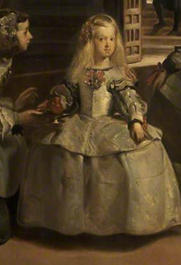 The Infanta is the visible “I” of the scene, yet she is merely a beautiful residue of the royal absence. The Infanta is the echo of vanished hovering authority. If look at her, she is hovering too. She is to Velázquez what a′ is to Lacan: the ego-ideal that covers the lack.
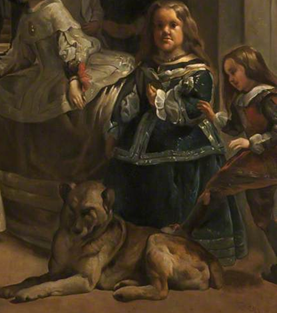 Near the bottom right lie the dwarf and the dog — the leftover. They are the material residue of the court’s structure. In Velázquez’s geometry, they are placed in the zone of inversion sink:
the point where imaginary sovereignty dissolves into real substance. This is the same function as the skull in Holbein’s Ambassadors: a secret object that destabilizes the entire perspective. Sovereignty is a viscous rotation that produces remainder.
They are not object a but its place-holder, Objet a is not the object of desire; it is the tear in the visual field that reveals desire. Velázquez places it openly, but subtly. If you remove the dwarf and dog, the structure collapses. This is where our work today becomes crucial. The L-schema in Lacan is usually drawn as static. But Las Meninas demands a dynamic version,
and a spiral provides it: The painting is therefore not a representation of a court scene.
It is a dynamical system.
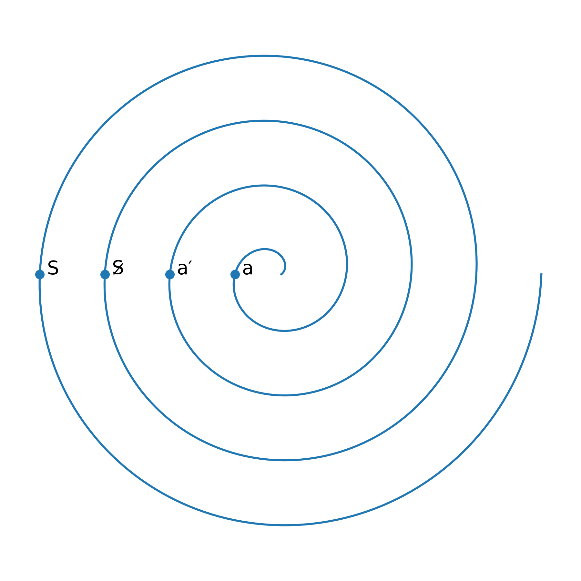
Outer coil: S (the sovereign as unary 1, mirror)
Next coil: S̷ (Velázquez, split subject)
Next coil: a′ (Infanta, ego-ideal)
Inner coil: a (dwarf/dog, remainder object)
Each coil represents an iteration of the inversion:
x(n+1) = 1 – x(n)
Power spirals inward, but meaning spirals outward. The viewer sits at the limit where the spiral touches infinity, the point where sovereignty locates itself only to vanish again. The true locus of sovereignty is not the king, not the Infanta, not the painter. It is a small region of air between the viewer and the mirror. A zone without substance, but with absolute structural necessity. This is what Lacan names objet a, what Rūmī names the empty I, what Hegel names the negation of negation, what Shakespeare dramatizes as the king’s annihilation in prison.
Conceptual Interlude: The L-Schema Before It Moves
This is, as you know, the L-Schema:
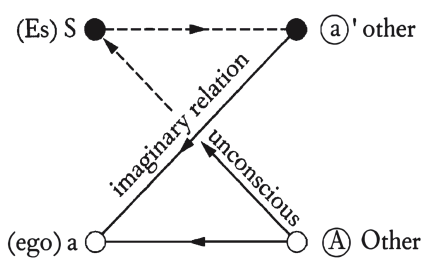
Lacan’s L-schema isolates the minimal structure of subjectivity and power. It consists of four places and two relations that cross without coinciding:
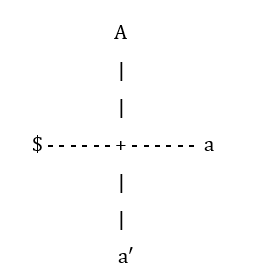 $ marks the barred subject: the one who speaks without coinciding with what is said.
A designates the big Other: not a person, but the locus of law, language, and recognition.
a′ names the ego-image: imaginary coherence, the mirror form of unity.
a marks the remainder: what cannot be symbolized and yet causes desire.
Two relations organize these points. The imaginary line (a′ ↔ a) governs rivalry and identification; the symbolic line ($ → A) governs speech and legitimacy. Their crossing without meeting means that communication is structurally misaddressed: what is said never arrives where it is intended, and what returns does so in inverted form.
The L-schema is static. It shows why identity, authority, and meaning never stabilize—but not yet how they circulate. As we seen in the former diagram, Las Meninas sets this structure into motion. By rotating these same four terms, it reveals sovereignty not as a position but as an effect of inversion: a void produced by the circulation of signifiers, images, and remainders.
Lacan: Inversion Geometry, the Slide-Rule, and the Recursion of 1 and a
If Hegel reveals the oscillation of power, if Rūmī dissolves the “I” into nothingness, if Shakespeare dramatizes sovereignty’s self-erasure, and if Velázquez paints a world where kingship exists only as reflection, then Lacan provides the mathematical and topological formalism that binds all these intuitions into a single structural model. His conceptual tools — the unary 1, objet a, S̷, a′, inversive geometry, Borromean recursion — are not metaphors. They are the architecture of how sovereignty, subjectivity, and desire function.
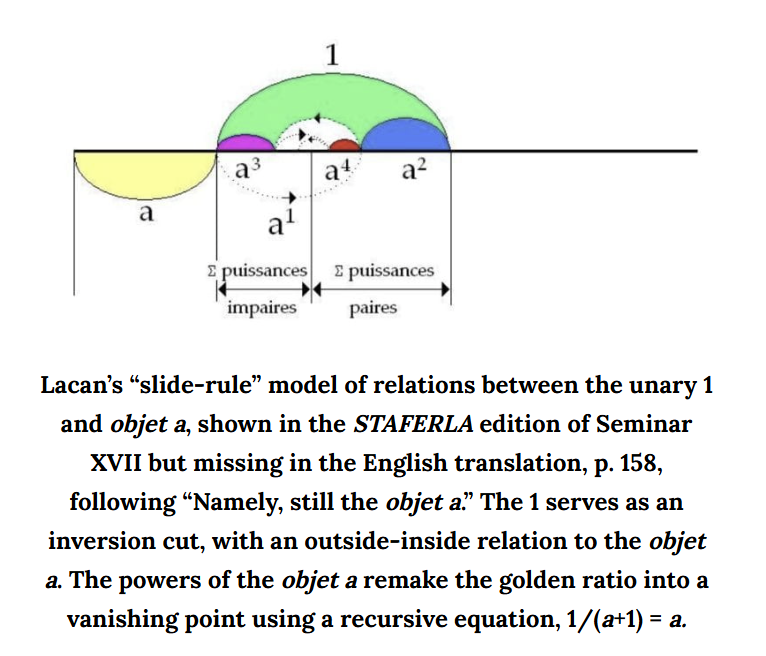
(check: the inversion project manifesto) In the STAFERLA edition of Seminar XVII , Lacan draws a diagram that did not survive in the English translation. This is the “slide-rule analogy,” a visual demonstration that: 1 (unary signifier) and a (object cause of desire) exist in a recursive relation. In simple algebraic form: a = 1 / (1 + a); This expression rearranges to: a(1 + a) = 1 Or a + a² = 1; This is a quadratic equation with the golden ratio (≈ 0.618) as one root. It shows that a is not an empirical object but a limit value, an attractor in a recursive system. We may write its generating recursion as:
a(n+1) = 1 / (1 + a(n))
Lacan uses the formula above not to describe numbers but to describe the subject and as such:
a is the point where inner and outer invert each other.
This is precisely the mechanism in Las Meninas, in Richard II’s prison monologue, in Rūmī’s “I am not I,” and in Hegel’s master–slave oscillation. 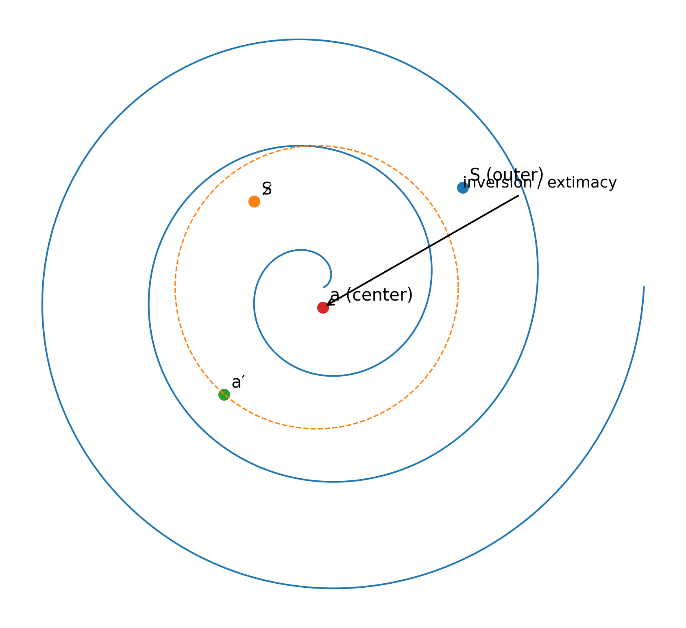 The spiral marks the ordered traversal of structural positions—S, S̷, a′, a—according to the recursive inversion x(n+1) = 1 − x(n). This visible progression, however, conceals its decisive topology: the outermost position (S, the unary signifier) and the innermost point (a, the remainder) are not opposed termini but coincide through inversion. The arrow indicates this extimate shortcut, by which exterior authority folds directly into the intimate kernel. Sovereignty does not reside at any point on the spiral; it emerges only in this loop, where reflection, negation, and remainder collapse into a single structural necessity. What appears furthest outside returns as the condition of the inside.
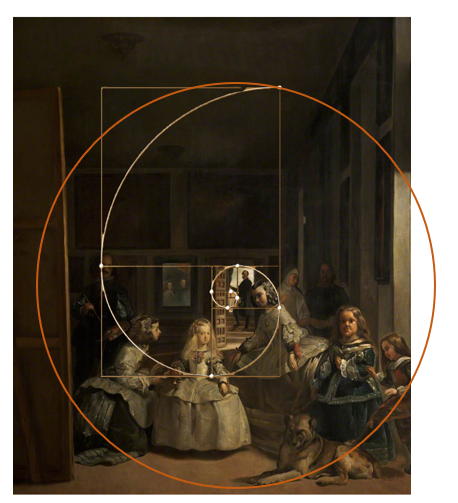
Discursive Rotation, Viscosity, and Residual Effects in Las Meninas.
The spiral and inversion circle formalize the painting as a rotating discursive structure articulated by unequal temporalities. The mirror indexes the place of the Other and the unary signifier; the painter occupies the position of the barred subject, anchoring symbolic enunciation without mastering it; the Infanta functions as ego-ideal, providing imaginary consistency. The dog and the dwarf do not represent objet a but mark the residual effects of discursive viscosity—points where circulation slows and synchronization fails. These figures materialize the lag produced by rotation, indexing the structural remainder from which objet a is retroactively inferred. What appears at ground level is not lack but excess: the necessary deposit left by a system that can only function by leaving something behind.
Lacan’s schema becomes dynamic here — and this is where your spiral diagram becomes essential.
CONCLUSION: Sovereignty as Rotation, Not Rule
The decisive claim of this essay, though unexpected, can now be stated without preparation:
the four discourses of Lacan are not a second model of power; they are the L-schema in motion.
What the L-schema fixes as misaddress, the discourses deploy as rotation. The elements do not change; the impossibility does not change. What changes is the mode of circulation: from a static crossing to a viscous rotation, a movement that never flows freely and never comes to rest. The passage of S₁, S₂, $, a is constrained, slowed, and marked by loss at each turn. Once this is seen, sovereignty loses its last metaphysical refuge. It is neither subject nor signifier, neither master nor law, but the rotation itself—a viscous permutation that produces remainder precisely because it cannot stabilize. Sovereignty exists only as this resistant movement and disappears the moment it claims a place.
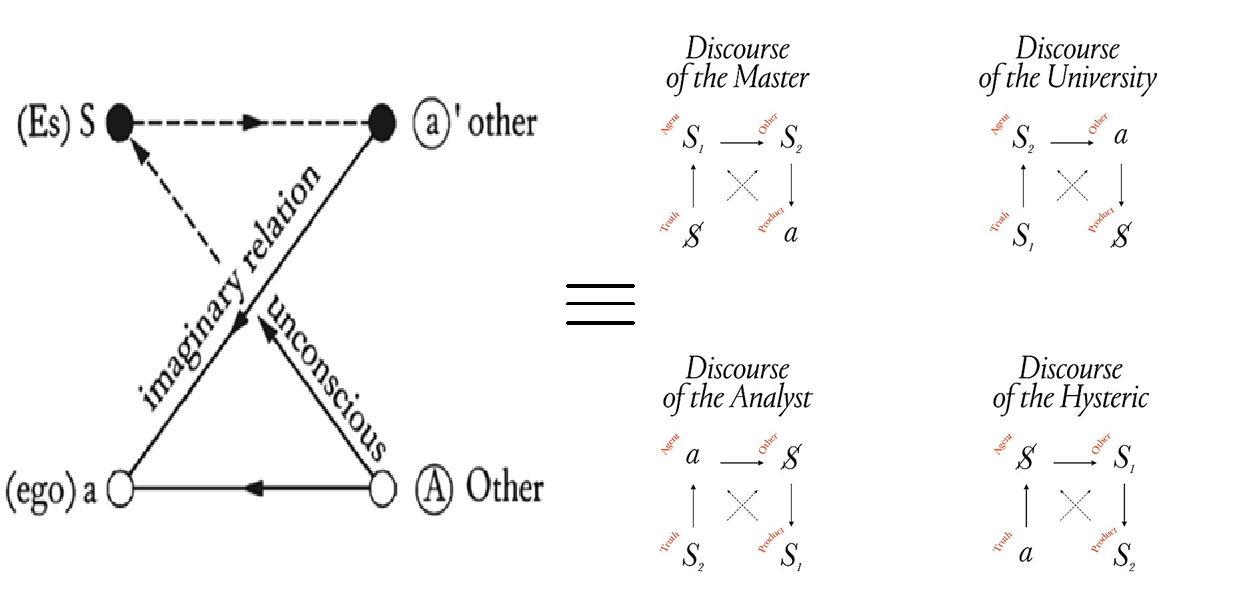
The discourses are the L-schema after rotation.
Las Meninas already inscribes the conclusion of this essay. The king appears only as reflection; the painter occupies the position of the barred subject; the Infanta functions as ego-ideal; the dwarf and the dog mark the remainder. These are not symbolic roles but structural positions. Nothing is represented. The painting operates as a machine: a rotating L-schema in which authority appears only as an effect of inversion. No figure occupies sovereignty. Sovereignty emerges only through circulation.
The same structure governs Richard II, where kingship persists only as self-cancellation, and Rūmī’s verse, where the “I” reaches truth only by becoming ∅. In each case, sovereignty coincides with the point at which identity fails and returns inverted. What seems to ground authority—name, body, crown, voice—functions only as cover. The operative core is elsewhere.
Once the equivalence is recognized—the discourses are the L-schema after rotation—sovereignty loses its last metaphysical support. It is neither subject nor signifier, neither master nor law. It is the compelled circulation of S₁, S₂, $, a through positions they cannot stabilize. This circulation is not frictionless. It is viscous. At each turn it produces a remainder. That remainder is not accidental; it is necessary. Sovereignty exists only insofar as something is left over.
Nothing further can be said without repeating this structure.
-
Authorship Note. This text is the product of an open collective discussion held during weekly IPSA sessions (11.12.2025). Its authorship is undecidable: Iraj, Claudio, Don, Quinn—or Not-I. ↑